For most of history, paying meant coins, notes, or a signed cheque. In one decade India leapt from cash-heavy markets to scanning a QR code at the chai stall —
powered by bank accounts, cheap smartphones, and the Unified Payments Interface.
This timeline follows cash and coin culture, cheques and clearing houses, debit cards and ATMs, NEFT/RTGS and IMPS, the 2016 UPI launch,
BHIM and popular apps, and the QR boom that made digital payments India-native and everyday.
Cash → Cards → UPINPCI · RuPay · BHIMQR at every shop
What Is a Payment System?
A payment system is how money moves from one person or shop to another — safely, quickly, and with a clear record.
India once relied almost entirely on cash and paper instruments. Banks then added cheques, cards, and electronic transfers.
UPI sits on top of bank accounts and mobile phones: you authorise a transfer in seconds, often by scanning a QR code, without typing long account numbers.
Big picture
Payments in India in one view
The story runs from bazaar cash and bank cheques, to plastic cards and ATMs, to bank wires that worked overnight, and finally to instant phone payments.
Related timelines:
banking in India,
Indian currency,
Digital India,
mobile phones.
From notes in the till to a phone scan — India’s payment leap in one frame (artistic illustration).
🪙 Cash FirstAncient – 1950s
Cash & Coin Economy
Coins and later banknotes were how most Indians settled everyday trades. Trust meant counting notes carefully, giving change, and keeping cash boxes safe —
habits that still shape how people feel about “real” money even after digital options arrived.
Cash dominated kirana shops, wages, and weekly markets for generations (artistic illustration).
Coins & notes: Punch-marked coins, Mughal and colonial coinage, and RBI notes after 1935 set the physical money people carried.
Daily life: Wages, rent, bus fares, and grocery bills were almost always settled in cash.
Risks: Theft, worn notes, shortage of change, and the need to visit a bank or post office for large sums.
Hundis & credit: Merchants also used traditional bills of exchange — covered more fully on the banking timeline.
Payment tools
Coins & currency notes: Legal tender for face-to-face trade.
Cash boxes & ledgers: Shop records of sales and credit.
Money orders: Post Office transfers for distant family support.
Features
Immediate: No waiting for a bank to clear the payment.
Universal: Worked even without a bank account.
Opaque: Harder to track than digital trails.
✍️ Paper Instruments1880s – 1990s
Cheques & Clearing Houses
As banking spread, businesses and salaried households used cheques to pay without carrying bags of cash.
Clearing houses sorted and settled millions of paper cheques — a system that MICR machines later sped up, but that still took days.
Cheques moved money between accounts once clearing houses finished their work (artistic illustration).
City clearing: Banks exchanged cheques in clearing houses so deposits became available after settlement.
MICR era: Magnetic ink characters let machines sort cheques faster in the 1980s.
CTS later: Cheque Truncation System (from 2008 onward) replaced moving paper with cheque images.
Limits: Bounce risk, delays, and the need for a bank visit kept cheques away from tiny everyday purchases.
Payment tools
Cheque books: Written orders to pay from your account.
Demand drafts: Bank-guaranteed paper for safer remittances.
Clearing cycles: Local vs outstation clearing times.
Features
Recorded: Bank statements showed the payment.
Business-friendly: Suited salaries, rent, and suppliers.
Slow for retail: Not practical for a ₹20 snack.
💳 Plastic & Cash Machines1987 – 2010s
Cards & ATMs
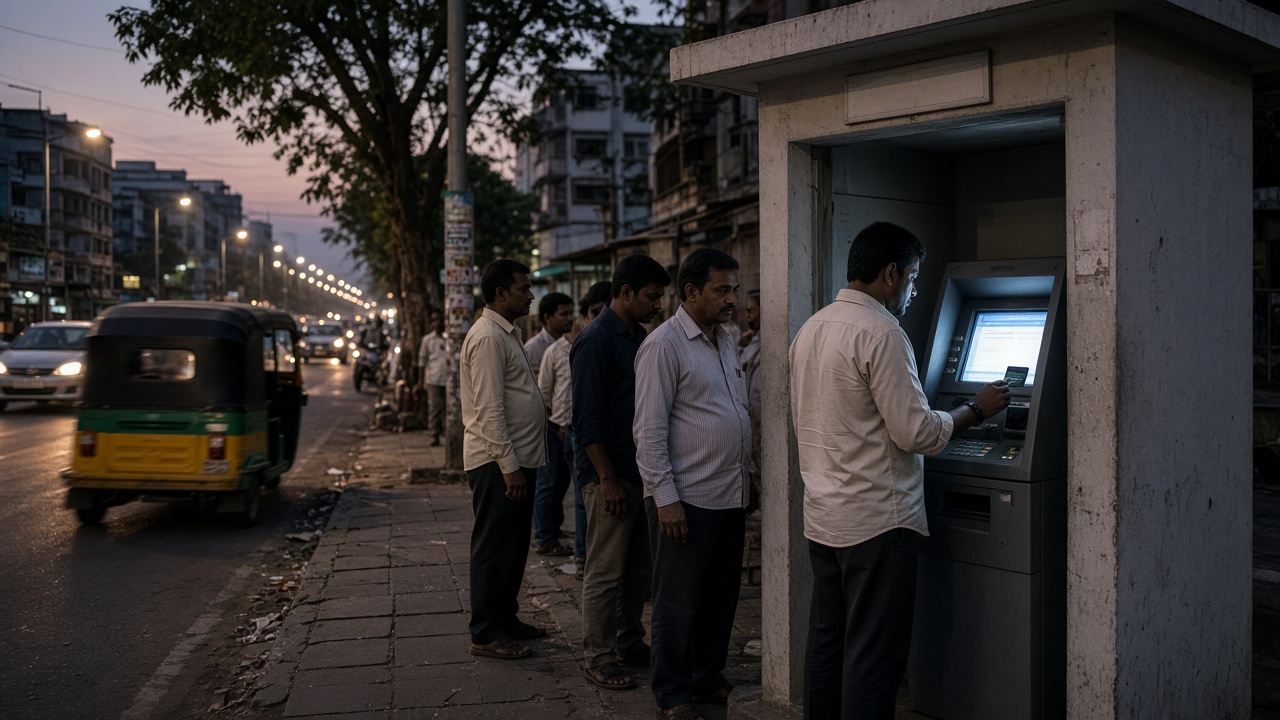
India’s first ATM opened in Mumbai in 1987. Debit and credit cards, POS swipe machines, and later RuPay brought plastic payments to malls, petrol pumps, and salaried cities —
while cash still ruled most street commerce.
ATMs and cards made bank money available after branch hours (artistic illustration).
1987 onward: ATMs spread with private banks in the 1990s; cash anytime became normal in cities.
Debit & credit: Cards linked spending to bank accounts or credit lines; merchants needed POS terminals.
2012 RuPay: NPCI’s domestic card network lowered costs and paired with Jan Dhan accounts.
Gap: Many kiranas could not afford terminals — a problem UPI QR later solved with a sticker and a phone.
Payment tools
ATM / debit cards: PIN-based cash and shop payments.
POS terminals: Merchants swipe or tap cards.
RuPay: India-built card rails.
Features
Convenience: Less cash to carry for large spends.
Fees & devices: Terminals and network costs limited tiny shops.
Urban tilt: Stronger in metros than villages at first.
🏦 Bank Rails2004 – 2015
NEFT, RTGS & IMPS
Electronic fund transfers let people send money without cheques. RTGS handled high-value real-time settlements; NEFT moved everyday amounts in batches;
IMPS (2010) added 24×7 mobile transfers — a crucial bridge to UPI.
NEFT, RTGS, and IMPS taught India to trust bank-to-bank digital money (artistic illustration).
2004–2005: RTGS and NEFT go live — electronic alternative to paper instruments for remittances and business payments.
2008: NPCI is formed to build retail payment systems for India.
2010: IMPS offers instant, round-the-clock transfers via mobile banking.
Still clumsy for shops: Account numbers, IFSC codes, and forms were fine for remittances — not for paying a street vendor ₹40.
Payment tools
RTGS: Real-time gross settlement for large sums.
NEFT: Electronic transfers of flexible amounts.
IMPS: Instant mobile-linked bank transfers.
Features
Account-based: Money stays inside the banking system.
Regulated: RBI oversight and bank KYC.
UX gap: Needed a simpler front door — UPI.
📱 Instant Interface2016 – 2018
UPI Launch
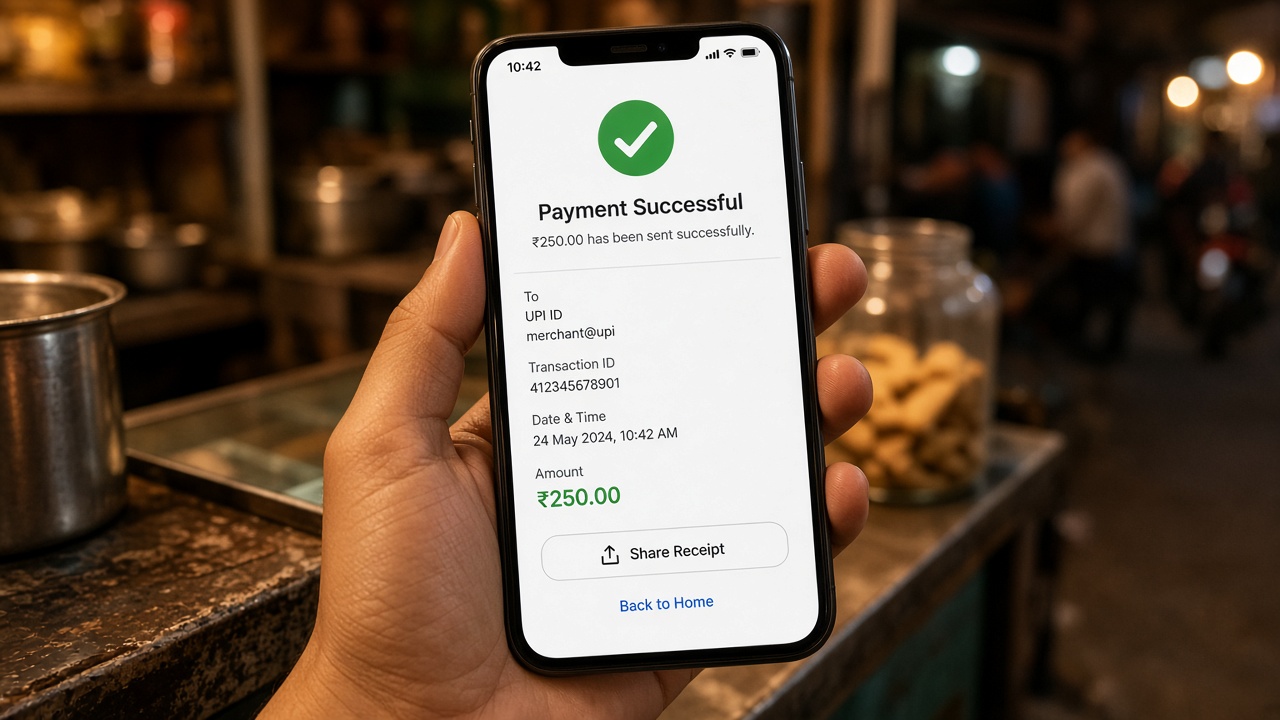
In April 2016 NPCI launched the Unified Payments Interface. One app could talk to many banks; a UPI ID or QR replaced long account numbers.
Demonetisation (November 2016) and the BHIM app pushed millions to try digital payments for the first time.
UPI made “send money now” feel as simple as a chat message (artistic illustration).
April 2016: UPI goes live — interoperable, real-time, built for smartphones.
Dec 2016: BHIM app from NPCI popularises UPI after the note ban.
Apps multiply: PhonePe, Google Pay, Paytm, and bank apps compete on the same rails.
Design win: Collect requests, intent flows, and UPI PINs made small payments friction-light.
Payment tools
UPI ID / VPA: name@handle addresses.
UPI PIN: Authorises debit from your bank.
Interoperability: Any UPI app ↔ any participating bank.
Features
Instant: Seconds, not clearing days.
Low cost: Free for most retail P2P/P2M use cases.
India-scale: Built as public digital infrastructure.
📷 Everyday QR2019 – Present
QR Everywhere & Scale
Printed QR stickers turned every tea stall, autorickshaw, and temple donation box into a digital merchant.
UPI volumes soared into billions of transactions a month; features such as UPI Lite, credit on UPI, and international linkages keep expanding the story.
A laminated QR sticker is often enough to accept payments — no POS machine required (artistic illustration).
Bharat QR & stickers: Static and dynamic QR codes standardise merchant acceptance.
Mass habit: Rent, school fees, groceries, and tips move over UPI alongside cash.
New layers: Autopay, credit lines on UPI, UPI Lite for offline-ish small spends, and cross-border pilots.
Safety focus: OTP/PIN hygiene, fake QR scams, and digital literacy become classroom and family topics.
UPI Lite / credit: Smaller wallets and credit-linked flows.
Features
Inclusive merchants: Tiny shops join the digital economy.
Traceable: Clearer payment histories than cash.
Always-on: Works late nights and holidays.
Ways to Pay: Then and Now
Cash, cheque, card, and UPI still coexist — different tools for different moments (artistic illustration).
Method
How it works
Best for
Cash
Notes and coins handed over
Tiny shops, places without phones/network
Cheque / DD
Paper order cleared by banks
Formal business and older workflows
Card (ATM / POS)
Plastic + PIN / swipe / tap
Malls, travel, cash withdrawal
NEFT / RTGS
Bank transfer with IFSC
Larger remittances and business payments
IMPS
Instant bank transfer
Urgent account-to-account sends
UPI
App / UPI ID / QR + PIN
Everyday P2P and merchant payments
Then vs Now
Then (cash & cheque era)
Notes counted at every shop counter
Cheques took days to clear
ATMs and cards mainly in cities
Small vendors rarely took plastic
Now (UPI era)
Scan QR, enter amount, enter PIN
Instant bank-to-bank settlement
Kiranas and autos accept digital pay
Cash still used — but optional for many
India spotlight
Why UPI feels India-native
UPI succeeded because India already had Jan Dhan accounts, Aadhaar e-KYC, cheap data, and a culture of small cash purchases that needed a zero-friction digital twin —
not just another wallet closed inside one company.
2008–2012
NPCI & RuPay
India builds its own retail payment institution and card network instead of relying only on foreign rails.
2014–2016
Accounts + phones
Jan Dhan, Aadhaar, and smartphones create the stack UPI sits on; UPI and BHIM launch.
2016–2018
Habit shock
Demonetisation and app competition teach millions to trust phone payments for daily spends.
2019+
QR nation
Stickers, soundboxes, and interoperable apps make UPI the default at countless small merchants.
Payment Milestones
Year
Milestone
What changed
Ancient–modern
Cash & coins
Face-to-face settlement with physical money
1880s+
Cheques & clearing
Bank-mediated paper payments
1987
First ATM in India
Cash without a teller
2004–2005
RTGS & NEFT
Electronic bank transfers
2008
NPCI formed
India’s retail payments utility
2010
IMPS
24×7 instant mobile transfers
2012
RuPay
Domestic card network
2016
UPI launched
Interoperable phone payments
2016
BHIM app
Public push for UPI adoption
2017+
Bharat BillPay & QR boom
Bills and merchant stickers scale up
2020s
Billions of UPI txns / month
Digital payments as daily habit
Timeline Summary
Era
Headline
Cash & coins
Physical money rules markets and wages
Cheques
Paper instruments for formal payments
Cards & ATMs
Plastic and cash machines in cities
NEFT / IMPS
Bank wires go electronic and then instant
UPI launch
One interface, many banks, smartphone-first
QR everywhere
Tiny merchants join the digital economy
Test Your Knowledge
20 quick questions from the UPI & digital payments timeline. Click each question to reveal the answer.
Answer: Unified Payments Interface.
Answer: NPCI (National Payments Corporation of India).
Answer: 2016 (April).
Answer: A virtual payment address such as name@bank that maps to your account.
Answer: Cash, cheques, demand drafts, or money orders.
Answer: Mumbai, in 1987.
Answer: National Electronic Funds Transfer and Real Time Gross Settlement.
Answer: Immediate Payment Service — 24×7 instant bank transfers launched in 2010.
Answer: India’s domestic card payment network from NPCI (2012).
Answer: Bharat Interface for Money — NPCI’s UPI app launched in December 2016.
Answer: A sticker and phone can accept payments without an expensive card POS machine.
Answer: UPI is interoperable across banks and apps; money moves between bank accounts on common rails.
Answer: Demonetisation of high-value notes (November 2016).
Click any panel to expand and explore the visual mood.
Payments in pictures — cash markets, cheques, ATMs, bank wires, UPI success screens, and QR stickers at street stalls.
Cash Economy
Notes & coins
Cheques
Paper clearing
Cards & ATMs
Plastic era
NEFT & IMPS
Bank rails
UPI Launch
From 2016
QR Everywhere
Street acceptance
Explore all economy timelines
Jump to any other economy timeline on WorldTimelineHub.
Disclaimer: This content is AI-generated for educational purposes and may contain errors or outdated details. For correct and authoritative information, please refer to official and reliable sources such as government publications, manufacturers, museums, and academic references.